Opuatia Stream
Enhancing our Environment
With the help of NZ Landcare Trust, we intend to reignite the environmental activities of the Upper Opuatia Community Catchment Group soon and invite you to be a part of them. You may already be an environmental champion, but you and your property will benefit further from connecting with your community and having greater access to a wider range of funding and resources.

Upper Opuatia Catchment Area
Our Waterways
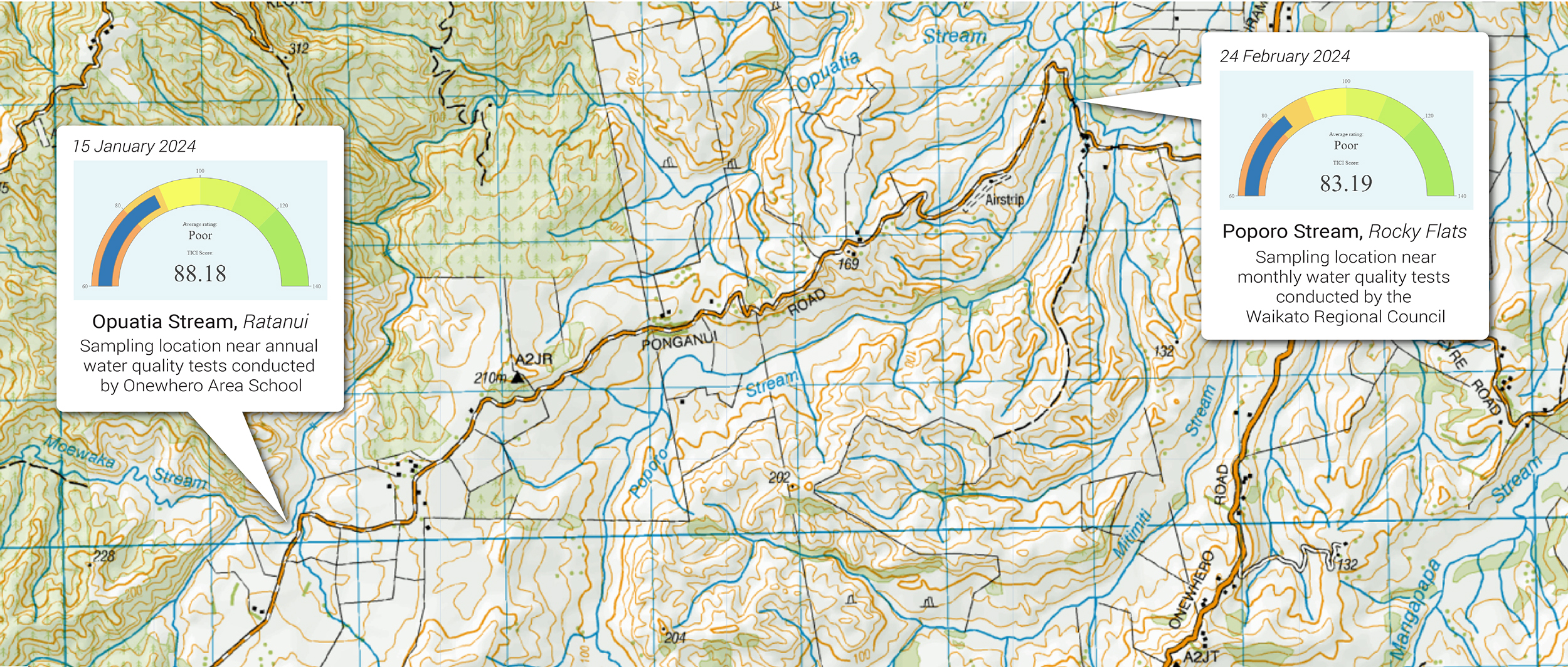
The NZ Landcare Trust very generously sponsored two eDNA tests for our catchment, creating a baseline of the ecological health of the Opuatia Stream in two locations. The samples were taken near the same locations where regular water quality testing is done (see the map attached). Information about the Taxon-Independent Community Index (TICI) measure can be found at www.wilderlab.co.nz/tici
The eDNA data is publicly available at www.wilderlab.co.nz/explore
eDNA Sampling, Measuring the Ecological Health of our Waterways
Opuatia Stream (Upper), Ratanui
Sampling location was near annual water tests conducted by Onewhero Area School.
The ecological health of the Opuatia Stream at this point is currently classed as POOR, which we found surprising. No koi carp or other major pest species were detected (this was expected, as there are several waterfalls downstream, preventing the fish from migrating upstream). The genetic material from longfin and shortfin eels, and koura (freshwater crayfish) was collected in this sample.
Poporo Stream (Lower), Rocky Flats
Sampling location near monthly water quality tests conducted by the Waikato Regional Council.
The ecological health of the Poporo Stream at this point is currently classed as POOR. Koi carp were detected at this location, as were other pest fish species – brown bullhead catfish, rudd, goldfish and mosquitofish. Brazilian waterweed, a pest plant species, was also detected. On a positive note, a significant amount of genetic material from longfin and shortfin eels was collected, and the presence of inanga (predominant whitebait species) was detected.
Current Environmental Initiatives
Many of our landowners have been already making improvements to our environment, including:
- Riparian fencing and planting
- Retired and planted marginal land with willows, poplars and natives
- QEII conservation blocks
- Poplar planting for hill country erosion control
- Removal of Crack willows and replaced with Matsudana willows
- Onewhero Area School annual Biology field trips (monitoring stream health and water quality)
- WRC monthly water quality tests where Poporo Stream joins the Opuatia Stream
- Pest control (bait stations)
- Silt traps
- Cattle exclusion zones
- Native plant nursery
- Bird surveys
- No synthetic fertiliser application (on some properties)
- No aerial spraying of herbicides (on some properties)
Further Actions & Opportunities
Next steps include identifying opportunities and actions that we can take across the catchment to enhance our environment. Consider the improvements you’d like to see, and the resources needed to achieve them. We will discuss priorities and plan our activities accordingly. We would love to hear about any improvements or activities that you’ve been working on too!
- Here are some potential actions that were discussed at our last catchment meeting:
- Water quality monitoring (eDNA tests, understanding current water quality data)
- Koi carp control/eradication
- Planting to prevent erosion
- Pest control (koi carp, possums, cats, stoats/weasels, rats, pigs, deer)
- Planting and protecting wetlands
- Increase biodiversity (fish, insects, birds)
- Best practice for farm track management (runoff) and culvert crossings
- Silt traps
- Best practice for riparian planting and fencing
- Biological weed control (e.g. ragwort flea beetle)
- No aerial spraying of herbicides across the catchment
- Establish multiple bird corridors
- Trees on farms workshop (ETS opportunities, alternative income trees e.g. Cork Truffle trees)
- Dung beetle workshop
- Improving soil fertility through pasture management
- Farm environment plans
- Flood-proof native fish passages
- Workshop on landowner obligations with respect to environmental regulations
- Working with the Waikato District Council to better manage water tables and storm water run-off